11 min read
 Weekly recap
US equities ended the week lower after the two-day Trump–Xi summit in Beijing failed to deliver the significant economic outcomes that markets had expected. The S&P 500 fell 1.24% on Friday to 7,408.50, the Dow Jones dropped 537 points (1.07%) to 49,526.17, and the Nasdaq declined 1.54% to 26,225.14. This decline followed record closing highs on Thursday, when the Dow Jones briefly exceeded 50,000 for the first time since February.
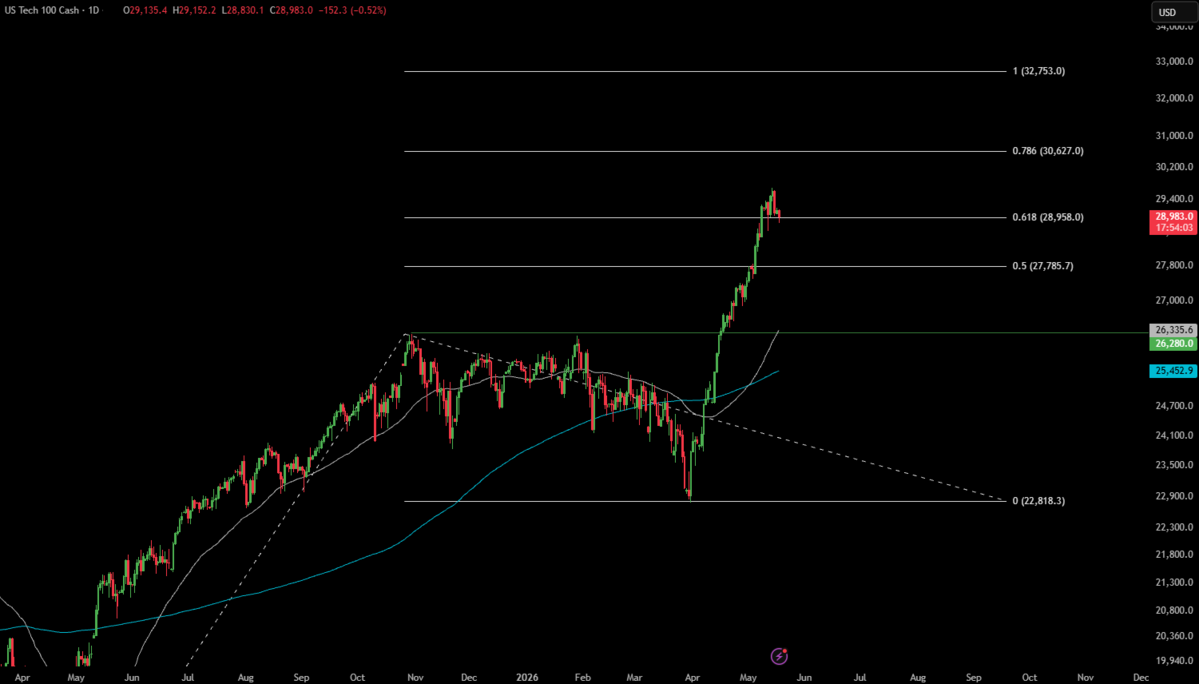
The main macroeconomic development was Kevin Warsh’s confirmation as the next Fed Chair in a narrow 54–45 Senate vote on Wednesday, the closest margin in the modern era and largely along party lines. Outgoing Chair Jerome Powell, whose term ended on 15 May, will remain as a governor. Markets have now fully ruled out a 2026 rate cut after April CPI rose 3.8% year-on-year, the fastest pace since 2023, and April PPI posted its largest monthly increase in four years.
Brent crude rose 2.15% on Friday to settle near $111 per barrel, marking a 6.90% weekly gain as the Strait of Hormuz remained effectively closed. Gold declined sharply to around $4,545 per ounce, ending the week down approximately 4% as rising US inflation reduced expectations for Fed easing. The US dollar strengthened: EUR/USD fell to 1.1617, its lowest in over a month, and USD/JPY extended its rally above 158.60 for a fifth consecutive day.
Trump–Xi summit fallout & Iran/Hormuz tensions
The Trump–Xi summit on 14–15 May in Beijing established a framework for “strategic stability” between the two largest economies but failed to meet market expectations. The only concrete outcome was a Chinese order for 200 Boeing aircraft, well below the 500 previously suggested by President Trump, leading to a 4% decline in Boeing shares on Friday. Xi invited Trump for a state visit on 24 September, and the existing trade truce, set to expire in October 2025, was extended. However, broader disputes over Taiwan, technology, and tariffs remain unresolved.
The Iran conflict remained unresolved during the summit. Trump stated that China “wants the straits open,” but no Beijing-mediated solution was achieved. Talks between Washington and Tehran have stalled, with Trump warning Iran to reach a deal or face “annihilation.” The IEA reported that crude and fuel flows through the Strait of Hormuz declined by about 4 million barrels per day in March and April, and warned that the global oil market will remain significantly undersupplied through October, even if hostilities end next month.
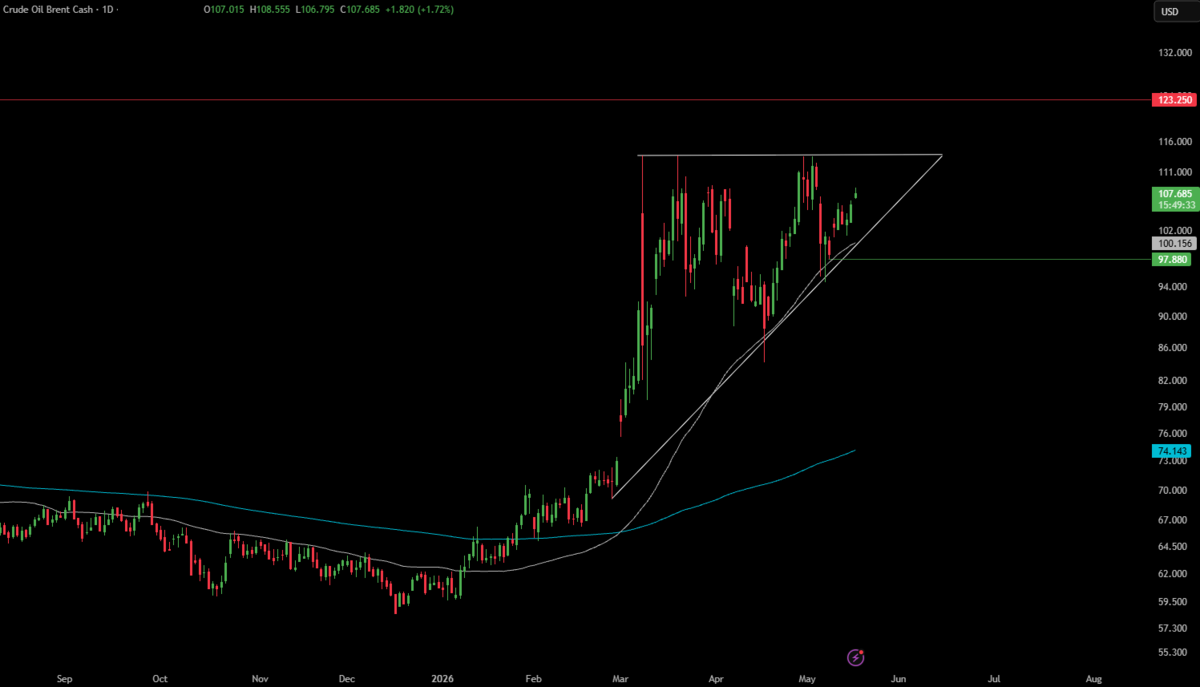
Brent remains a primary driver of inflation and is shaping the interest rate outlook. Additional increases in oil prices would intensify the inflation shock seen in US CPI and PPI, while a credible ceasefire would likely bring Brent price back toward $90.
Canadian CPI (Tuesday)
Canada’s April CPI will be released on Tuesday, 19 May at 15:30 GMT+3 and will be the first inflation report to fully capture the impact of the Iran conflict on Canadian consumer prices. Headline CPI rose to 2.4% year-on-year in March, up from 1.8% in February, driven by a record 21.2% monthly increase in gasoline costs. The carbon levy base-year effect will not be fully cleared until the April release, so the headline rate could rise further.
The Bank of Canada has maintained its policy rate at 2.25%, with policymakers highlighting two-sided risks from the energy shock: higher inflation alongside weaker growth and a slowing labour market. Bank of Canada minutes indicate that labour market weakness is concentrated in trade-exposed sectors, and any acceleration in the headline CPI, driven mainly by gasoline, will be assessed cautiously rather than viewed as a trigger for rate hikes. The CPI-trim and CPI-median core measures will be more influential for the policy outlook than the headline figure.
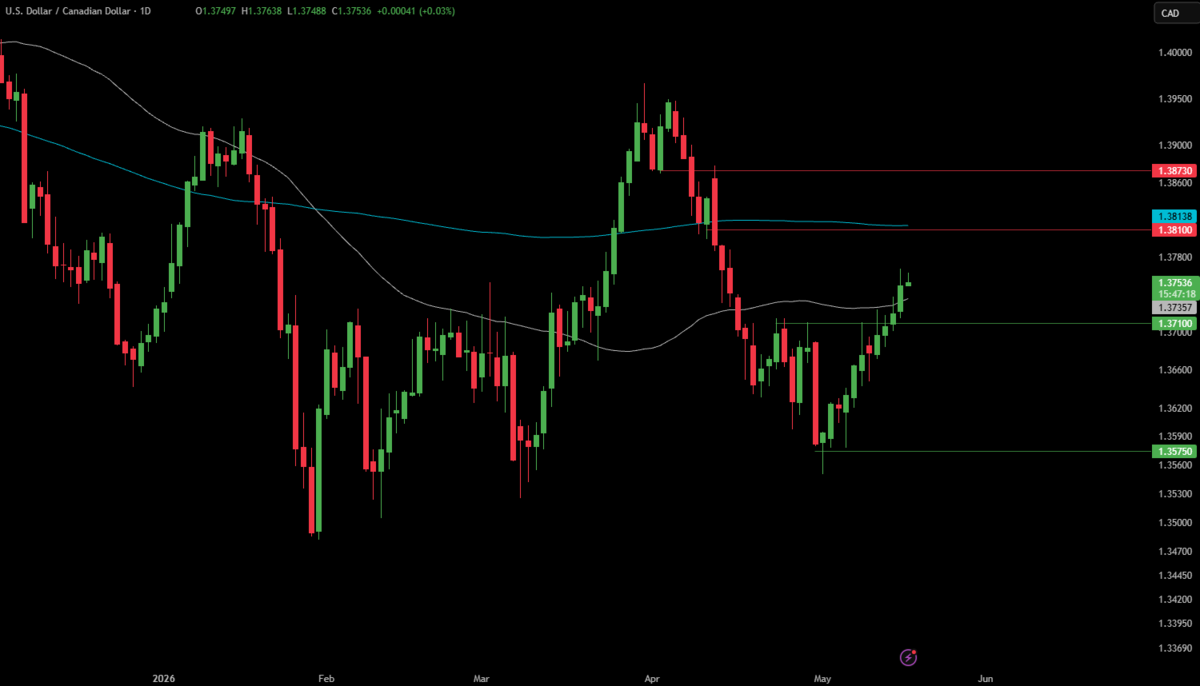
A strong core CPI reading would reduce market expectations for a near-term BoC rate cut and support the Canadian dollar against the USD. With USD/CAD trading in the upper part of its 2026 range, a significant upside surprise in core CPI could push USD/CAD toward 1.3575. Conversely, a soft-core reading combined with headline-driven, high-energy inflation would keep USD/CAD supported and open the path to 1.3810 and 1.3873.
UK CPI (Wednesday)
The Office for National Statistics will release UK CPI for April on Wednesday, 20 May at 09:00 GMT+3. March CPI rose to 3.3% year-on-year from 3.0% in February, with motor fuels jumping 4.9% on the month and domestic heating oil up 95.3% year-on-year — the largest such move since September 2022. Core CPI eased slightly to 3.1% from 3.2%, while services inflation ticked up to 4.5%, a figure the Bank of England closely watches as a gauge of domestic price pressures.
This will be the first inflation print since the Bank of England’s April Monetary Policy Report, which lifted near-term CPI projections by 1.4 percentage points and now sees headline CPI at 3.3% in Q3 — and likely higher into Q4. The April MPC vote was 8–1 to hold Bank Rate at 3.75%, with one member voting for a 25 bp hike. Governor Andrew Bailey has flagged risks skewed to the upside, and UK rate markets are pricing in roughly 60 basis points of tightening into year-end.
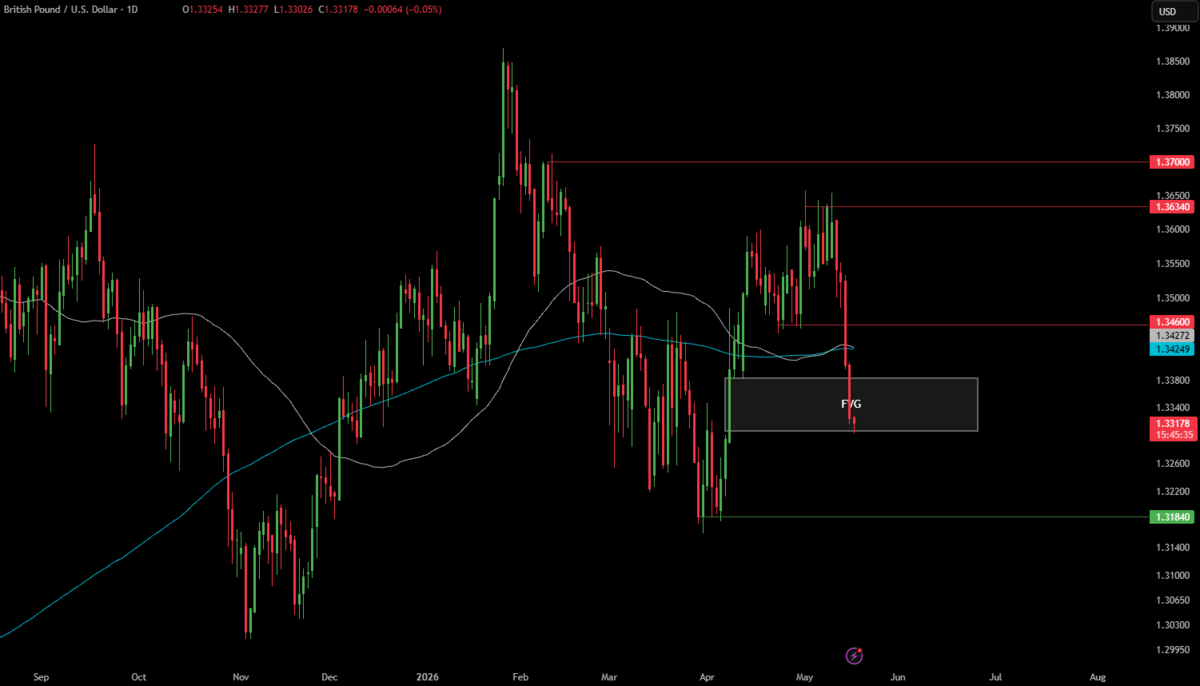
A strong reading, particularly in services CPI, would reinforce current market pricing and could lift GBP/USD from the 1.33 FVG area. A weaker result, especially in services, would weaken the BoE’s near-term case and likely push GBP/USD toward 1.3184 support.
FOMC minutes (Wednesday)
The minutes of the 28–29 April FOMC meeting will be released on Wednesday, 21 May at 21:00 GMT+3. This meeting was Jerome Powell’s last as Chair, with the Fed maintaining the federal funds target range at 3.50%–3.75% and Stephen Miran again dissenting in favour of a cut. Three other members, while not voting for a hike, expressed increasing concern about persistently above-target inflation, which is unusually hawkish for a meeting where rates were held steady.
Since that meeting, April CPI has reached 3.8% year-on-year, and April PPI has recorded its largest monthly increase in four years. Kevin Warsh has been confirmed as Fed Chair in a divisive 54–45 vote. Markets have now fully repriced the Fed’s outlook: CME FedWatch assigns a near-zero probability of a 2026 cut, while some traders see about a 50% chance of a December hike. Warsh’s first meeting as Chair will be 16–17 June, making the April minutes a key indicator of the transition.
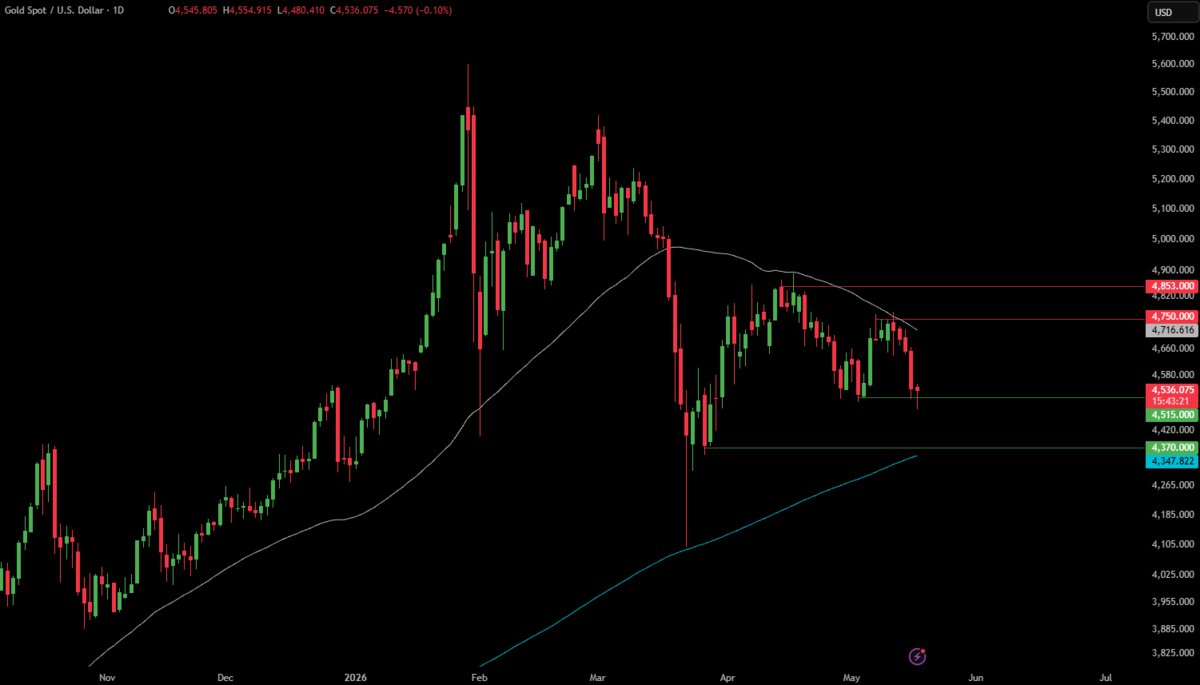
Hawkish minutes, especially if members acknowledge the case for raising rates, would strengthen real-yield support for the dollar and further pressure Gold, which has already declined from January’s $5,602 high to $4,545. On the other hand, dovish language highlighting downside risks to growth from oil could support Gold and limit the recent USD rally.
NVIDIA earnings (Wednesday)
NVIDIA will report Q1 fiscal 2026 results on Wednesday, 20 May, after the US market close. Wall Street consensus, according to Visible Alpha and FactSet, is for revenue of approximately $78.8 billion and non-GAAP EPS of $1.77, compared to Nvidia’s guidance of $78 billion plus or minus 2%. Non-GAAP gross margin is expected to be around 75%, with the company assuming no Data Centre compute revenue from China in its outlook.
Forward guidance for Q2 will be more significant than a Q1 earnings beat. Consensus currently expects about $86 billion in Q2 revenue; guidance below this level, even after strong Q1 results, has historically led to immediate downside. Investors will also seek updates on the Blackwell-to-Rubin generational transition, supply constraints at TSMC and advanced-packaging partners, and any developments regarding US export restrictions, particularly following Jensen Huang’s attendance at the Beijing summit and reports that about ten Chinese tech companies have been cleared to purchase advanced Nvidia chips. Options markets are pricing in a 5–10% move on the results.
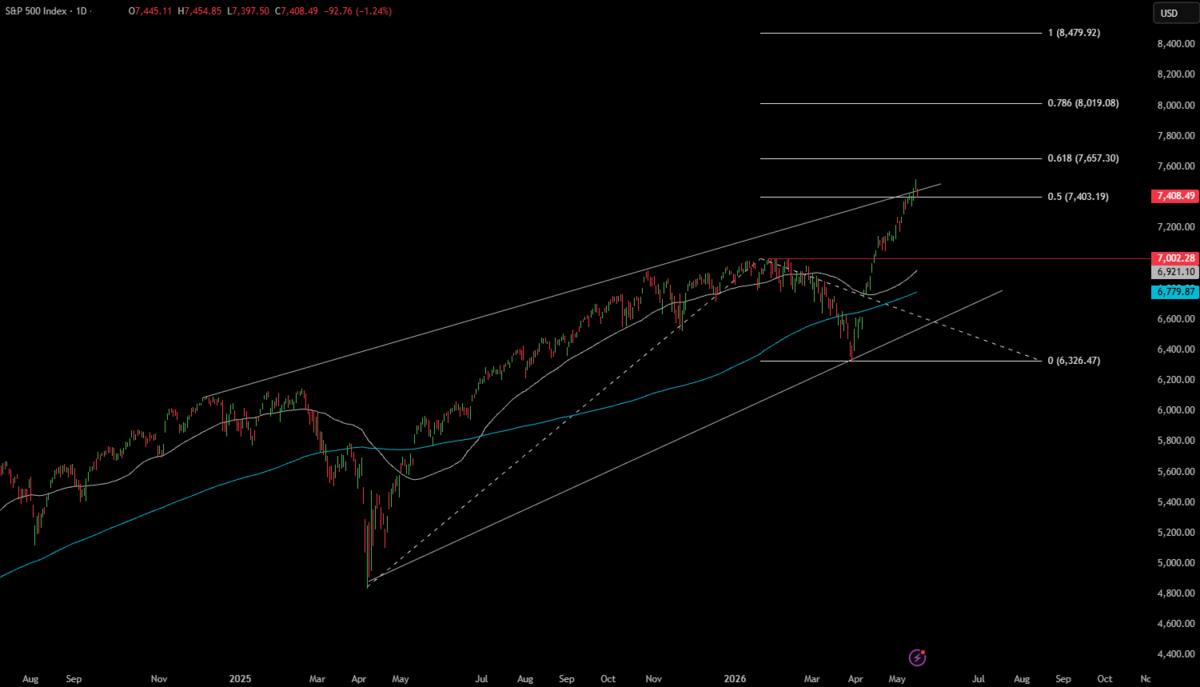
NVIDIA represents a significant portion of S&P 500 earnings and market capitalisation, and Friday’s tech-led selloff has already reduced some of the recent momentum in the AI sector. A strong beat-and-raise would likely drive the S&P 500 higher toward 7650, while a weak Q2 outlook or negative margin commentary could weigh on the S&P 500 and broader risk sentiment heading into the long weekend.
Global flash PMIs (Thursday)
Flash PMIs for Germany, France, the Eurozone, the UK, and the US will be released on Thursday, 22 May. The April data highlighted the producer–consumer divide resulting from the Iran conflict: the Eurozone composite fell into contraction at 48.6, led by services at 47.4, a 62-month low, while manufacturing remained strong at 52.2 due to stockpiling ahead of anticipated price increases. The US composite remained in expansion at 52.0, with manufacturing at a near four-year high of 54.0. The UK exceeded expectations at 52.0, with both components above 50.
The main focus for May is whether the decline in services has stabilised and if the manufacturing stockpile is beginning to slow. Input and output price components have already reached multi-year highs, especially in the Eurozone, and any further increase would strengthen the case for the ECB to counter second-round effects rather than ease policy. ECB markets are currently pricing in about 50 basis points of tightening for 2026.
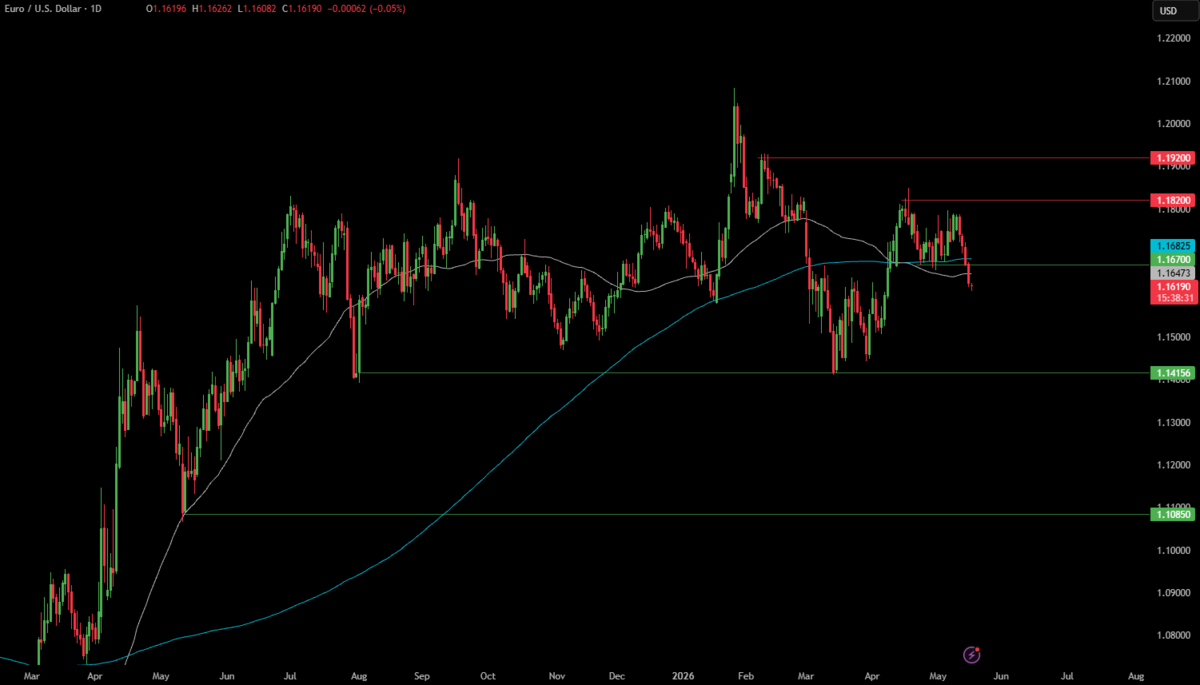
A weaker Eurozone services reading or another spike in price components would put additional pressure on EUR/USD after last week’s decline below 1.1670. A clear rebound in Eurozone services, combined with stable US data, would support the ECB’s continued hawkish stance and could help EUR/USD recover toward 1.18.
Japan GDP & national CPI (Tuesday & Friday)
Japan’s preliminary Q1 GDP will be released on Tuesday, 19 May at 02:50 GMT+3. A Reuters poll of 17 economists forecasts annualised growth of 1.7% (0.4% quarter-on-quarter), up from 1.3% in Q4 2025. Private consumption and capital expenditure are expected to remain strong, with limited impact from the Middle East at this stage. National CPI for April will be released on Friday, 22 May: March figures were 1.5% headline and 1.8% core, while the Tokyo April print released earlier this month was softer than expected at 1.5% headline and 1.9% core-core, below the 2.3% consensus.
This context is important because the BoJ kept rates at 0.75% in late April, with three members dissenting in favour of a hike to 1.0%. The April Outlook Report raised the FY2026 core CPI forecast to a 2.5%–3.0% range, and a Reuters poll shows nearly two-thirds of economists expect a June 16–17 hike to 1.0%. A soft national CPI reading combined with fuel-subsidy effects would give the BoJ reason to delay, while stronger GDP and any upside surprise in core CPI would solidify expectations for a June hike.
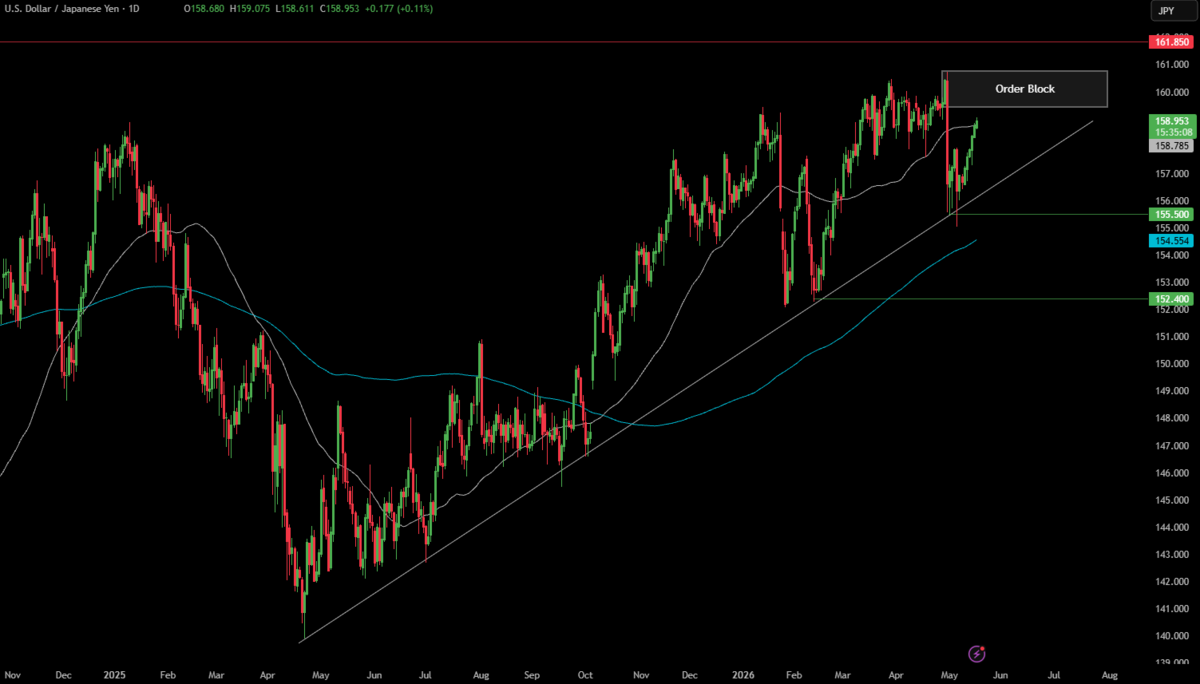
USD/JPY most directly reflects these dynamics. The pair has rallied for five consecutive sessions to around 159.00, supported by a stronger dollar and a cautious BoJ. A hawkish data combination, such as solid GDP and stronger-than-expected core CPI, would strengthen the yen and push USD/JPY lower. Another soft CPI result would likely extend the rally toward the OB around the 160 level, which has previously drawn the Ministry of Finance’s attention.
Bottom line
The Iranian energy shock remains the primary macroeconomic driver, influencing all major events on this week’s calendar. Any sign of de-escalation around the Strait of Hormuz would allow Brent to decline, supporting a recovery in risk assets. The April FOMC minutes and Nvidia’s Q2 guidance on Wednesday are the key risk events, with the S&P 500 and US 100 particularly sensitive.
Trading involves risk.
Author



 Risk Disclaimer
The content provided here is for informational purposes only. It is not intended as personal investment advice and does not constitute a solicitation or invitation to engage in any financial transactions, investments, or related activities. Past performance is not a reliable indicator of future results.
The financial products offered by the Company are complex and come with a high risk of losing money rapidly due to leverage. These products may not be suitable for all investors. Before engaging, you should consider whether you understand how these leveraged products work and whether you can afford the high risk of losing your money.
The Company does not accept clients from the Restricted Jurisdictions as indicated in our website/ T&C. Some services or products may not be available in your jurisdiction.
The applicable legal entity and its respective products and services depend on the client’s country of residence and the entity with which the client has established a contractual relationship during registration.