7 min read
 The Nikkei has pulled back from Thursday’s intraday record above 63,700 to trade around 60,800 on Monday, with the index now testing a key support level after a sharp three-day reversal. Friday’s close around 61,400 snapped the index’s record-setting run, and Trump’s weekend escalation in Iran rhetoric has added fresh pressure to the open this week.
The pullback comes against a stack of headwinds that have all converged at once.
Key takeaways
- The Nikkei is testing key support after pulling back from Thursday’s intraday record above 63,700
- Brent has surged back above $110 after Trump warned Iran that the “Clock is Ticking”, hitting Japan particularly hard as one of the world’s largest oil importers
- The 10-year JGB yield has climbed to around 2.8%, near its highest level since 1997, with markets now pricing a high probability of a BoJ rate hike at the 16-17 June meeting
- Friday’s US tech sell-off hit Nikkei semiconductor heavyweights hard, with Advantest down almost 8%, Disco down around 7%, and Kioxia and Fujikura both down over 8%
- The early signs of yen strength flagged in our last USD/JPY article are now starting to bleed into the equity market
A stack of headwinds is converging on Japan
In our last Nikkei article, we framed the breakout as AI and tech leadership igniting a record-setting rally. That thesis has played out cleanly, with the index surging over 3,000 points on 7 May to close at a record around 62,800 post-Golden Week, and then briefly tagging above 63,700 intraday on Thursday. The same leadership names that drove the rally are now leading the pullback.
The first headwind is the BoJ. The 10-year JGB yield has climbed to around 2.8%, near its highest level since 1997, after BoJ board member Kazuyuki Masu publicly stated that it is “desirable to raise the policy rate at the earliest stage possible”. Markets are now pricing a high probability of a hike to around 1.00% at the 16-17 June meeting, which could potentially put further pressure on the yen-funded carry trade that has been supporting Japanese equities. This is the same dynamic we flagged in our recent USD/JPY piece, and it is now starting to show up in Tokyo.
The second is oil. Japan imports around 95% of its crude from the Middle East, with the vast majority passing through the Strait of Hormuz, which has been effectively closed since late February. Trump’s weekend posts on Truth Social warning Iran that the “Clock is Ticking” sent Brent back above $110 in Monday Asia trade. April PPI in Japan came in at around 4.9% YoY, the highest since 2023, and household spending has now fallen for four consecutive months. Every dollar of oil above $90 is effectively a direct tax on Japan Inc.
The third is the AI leadership group. Friday’s US tech sell-off (Nvidia down over 4%, Intel down around 6%, AMD down nearly 6%, Micron down nearly 7%) hit the Nikkei’s heaviest constituents particularly hard, with Advantest down almost 8%, Disco down around 7%, and Kioxia and Fujikura both down over 8%. Advantest alone makes up around 10% of the index, so what happens to the AI/semi complex tends to move the Nikkei more than almost any other single factor.
Daily chart
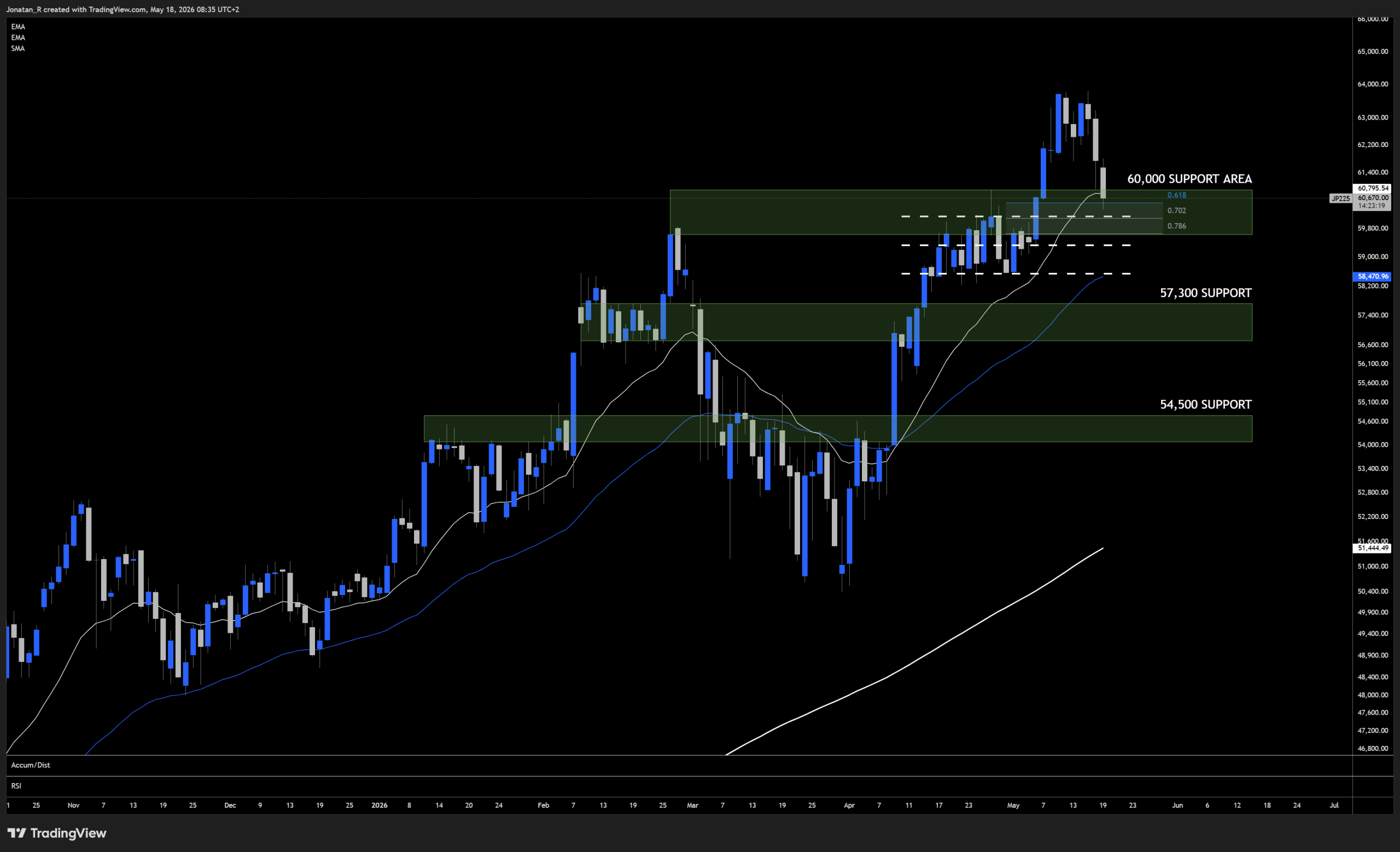
On the daily chart, the Nikkei broke out of the previous consolidation phase and into all-time highs on 7 May. Since then, the index has retraced back down and is now testing the 60,000 support area, which is a confluence of the daily 20 EMA, the previous breakout area, and the highs of the prior consolidation phase.
Technically, the trend still looks alive, and this retrace could potentially be a dip within an overall strong uptrend rather than the start of a reversal. The retest is also taking place within a local long reload zone, with a wick currently being created right on the 0.618 fib at the time of writing.
- A failure to hold this level could potentially send price back into the previous consolidation range around 59,000, and from there potentially down to the 57,300 support area
- The daily 50 EMA is another level to watch as a potential secondary support
- Below that, the 54,500 support area marks the next major horizontal level on the way down
- A clean reclaim of the 60,000 area could potentially keep the broader uptrend intact and open the door to a retest of the 63,700 highs
4-hour chart
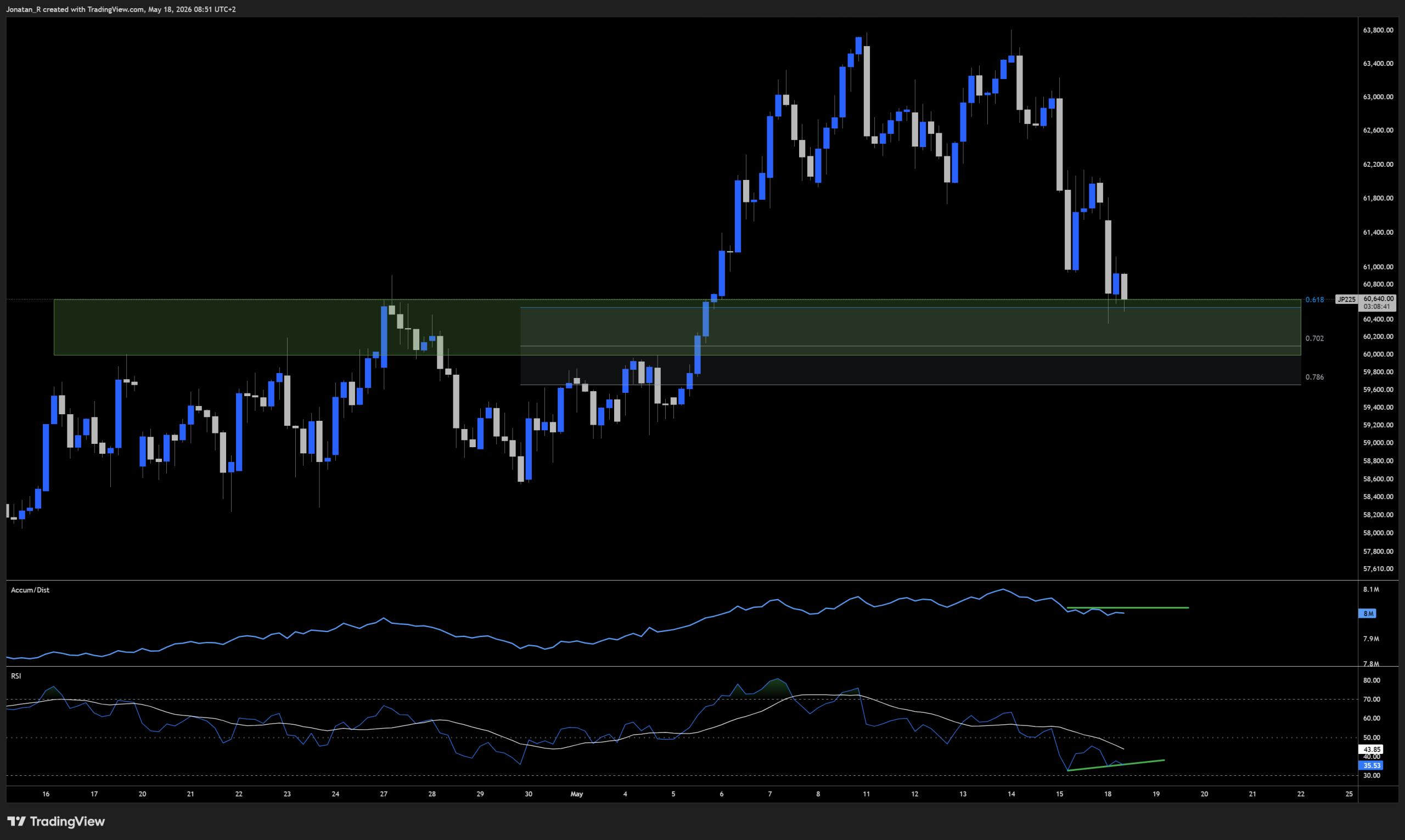
On the 4-hour timeframe, the Nikkei is currently testing the 0.618 fib of the local reload zone. Looking at the RSI at the bottom of the chart, a potential bullish divergence could be forming, which is worth watching for a possible bounce at current levels.
If the bullish divergence on the RSI plays out, we could also potentially see the Accumulation/Distribution line break above the green horizontal level on the chart. That could potentially be confirmation of this being a level where buyers are coming in and defending the area for a potential move higher.
What to watch
- The 60,000 support area as the immediate decision point, confluent with the daily 20 EMA, the previous breakout level, and the 0.618 fib
- The 57,300 support area below as the next major level if 60,000 fails to hold
- The 54,500 support area as the deeper structural level
- A potential bullish RSI divergence on the 4-hour timeframe and confirmation from the Accumulation/Distribution line
- The BoJ meeting on 16-17 June, with markets pricing a high probability of a rate hike
- Any further developments around Iran and the Strait of Hormuz, particularly any change in Trump’s rhetoric
- The US tech tape as a leading indicator for the AI/semi heavyweights that dominate the Nikkei
Trading involves risk.
Author



 Risk Disclaimer
The content provided here is for informational purposes only. It is not intended as personal investment advice and does not constitute a solicitation or invitation to engage in any financial transactions, investments, or related activities. Past performance is not a reliable indicator of future results.
The financial products offered by the Company are complex and come with a high risk of losing money rapidly due to leverage. These products may not be suitable for all investors. Before engaging, you should consider whether you understand how these leveraged products work and whether you can afford the high risk of losing your money.
The Company does not accept clients from the Restricted Jurisdictions as indicated in our website/ T&C. Some services or products may not be available in your jurisdiction.
The applicable legal entity and its respective products and services depend on the client’s country of residence and the entity with which the client has established a contractual relationship during registration.