8 min read
 Bitcoin’s price action has been frustratingly range-bound, but beneath the surface the fundamental backdrop continues to shift. Today brings a potential turning point as the US Senate Banking Committee holds a markup vote on the CLARITY Act, the most comprehensive piece of crypto legislation ever to reach this stage of the legislative process.
Key points:
- The Senate Banking Committee is holding a markup vote on the CLARITY Act today at 14:30 UTC
- The bill could potentially convert Bitcoin’s commodity classification from administrative guidance into federal statute
- Citi cut its Bitcoin target to $112,000 in March, citing the stalled bill. Its previous $143,000 base case was tied directly to CLARITY passage
- On the chart, Bitcoin has rejected at the 80,000 to 85,000 resistance zone and pulled back to test the daily 20 EMA
- The broader uptrend from the February low near 60,650 appears intact
In our previous Bitcoin analysis, we covered how Bitcoin bounced back to the 80,000 region despite the collapse of the Middle East ceasefire. Since then, hot inflation prints and the looming CLARITY vote have taken centre stage.
What is the CLARITY Act?
The Digital Asset Market Clarity Act of 2025 is the first comprehensive piece of US legislation that attempts to define how digital assets should be regulated. At its core, the bill divides regulatory authority between two agencies:
- The SEC retains jurisdiction over digital assets that qualify as securities
- The CFTC gains exclusive jurisdiction over digital assets classified as digital commodities, including their spot markets
For Bitcoin specifically, the bill could cement its status as a digital commodity in federal statute. While the SEC and CFTC have already classified Bitcoin as a commodity through administrative guidance, that classification could potentially be reversed by a future administration. CLARITY could convert it into law that no regulator could undo with a simple memo.
Why today’s vote is a critical milestone
The CLARITY Act passed the US House of Representatives on 17 July 2025 with a strong bipartisan vote of 294 to 134. Since then, it has been stalled in the Senate, primarily over disagreements on stablecoin yield provisions and conflict-of-interest language.
Today’s markup is the first formal Senate committee vote on the full text of the bill. The Banking Committee is composed of 13 Republicans and 11 Democrats. Chairman Tim Scott appears to need all 13 Republican votes to advance the bill, and Senator John Kennedy, who had been the key holdout, reportedly told Semafor earlier this week that he plans to support the bill.
Over 130 amendments have been filed ahead of the vote, with 44 of those coming from Senator Elizabeth Warren alone. Most are expected to fail along party lines.
What happens if it passes today
A clean markup vote could advance the bill out of committee, but the path doesn’t end there. The bill still needs to be merged with the parallel version that already cleared the Senate Agriculture Committee, which has jurisdiction over the CFTC. After that, it needs 60 votes on the Senate floor, meaning meaningful Democratic support is required, and then reconciliation with the House version before reaching the President’s desk.
The White House is targeting 4 July for a signature, but the deadline is tight. Memorial Day recess begins on 21 May, and Senator Cynthia Lummis has warned that missing this window could push the bill back significantly. Polymarket currently prices the odds of passage in 2026 at around 60%.
Why this matters for Bitcoin
Beyond the legal clarity, the bigger story is what CLARITY could potentially unlock. Pension funds, insurance companies, and sovereign wealth funds remain largely blocked from meaningful crypto allocations without statutory clarity from Congress. CLARITY could be the gate that opens that door.
Citi cut its 12-month Bitcoin target from $143,000 to $112,000 in March, citing the stalled CLARITY Act as a key factor. The bank had previously tied its $143,000 base case directly to CLARITY passage, projecting around $15 billion in additional net ETF inflows once the bill clears Congress. A clean markup today could shift those probabilities back in the bull case’s favour.
On top of that, the structural picture is already supportive:
- Spot Bitcoin ETFs and listed treasury companies now hold roughly 12% of total Bitcoin supply
- Exchange reserves have fallen to seven-year lows at approximately 2.21 million BTC
- Whale wallets accumulated around 270,000 BTC in April alone, the largest single-month pace since 2013
If the markup passes today, expectations for a summer signing could potentially accelerate, and the institutional flow story could regain momentum. If it stalls, Bitcoin may remain range-bound while traders wait for the next catalyst.
Bitcoin daily chart
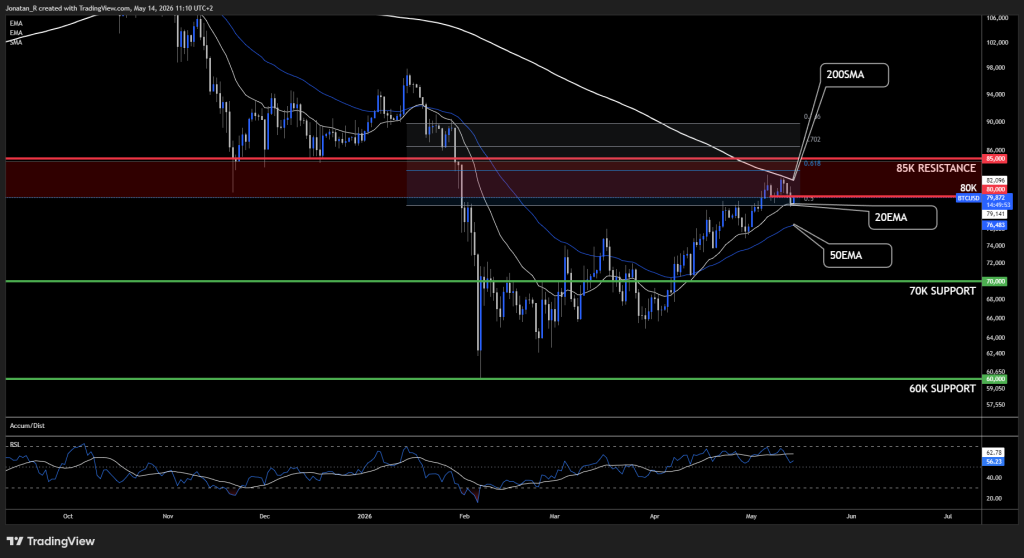
On the daily chart, Bitcoin has seen a local break to the downside, with price slipping below the 80,000 region, marked by the red horizontal line. The move came after price rejected from the daily 200 SMA, which is positioned right inside a major high timeframe resistance zone between 80,000 and 85,000.
This resistance zone appears reinforced by a confluence of factors. The 0.618 Fibonacci retracement of the prior decline aligns with the same area, and the daily 200 SMA sits within it. That confluence could help explain why price has struggled to break through on the latest attempt.
Despite the rejection, the broader structure remains constructive. Price has found support on the daily 20 EMA, with the 50 EMA sitting just beneath it, both sloping higher. The structure of higher lows from the February low near 60,650 appears intact, and the RSI continues to hold above the 50 level, keeping the indicator within its bullish range per the Cardwell framework.
Key levels to watch
Resistance:
- 80,000 — local resistance and the level price just broke below
- 85,000 — upper boundary of the high timeframe resistance zone, reinforced by the 200 SMA
Support:
- 76,500 — area of the daily 20 EMA, current short-term support
- 70,000 — major horizontal support that held through March and April
- 60,000 — the February low and the structural floor for the uptrend
What to watch next
The CLARITY Act markup vote at 14:30 UTC is the immediate catalyst. A clean pass could potentially shift sentiment in favour of risk assets and provide a tailwind for Bitcoin to retest the 80,000 to 85,000 resistance zone. A failure or delay could keep price pinned below resistance while the market waits for the next catalyst.
On the chart, the structure could remain constructive as long as Bitcoin holds above the daily 20 and 50 EMAs. A sustained break above 85,000 could be the technical signal that the broader uptrend is ready to resume. A break below 70,000 could call the bullish structure into question.
Trading involves risk.
Author



 Risk Disclaimer
The content provided here is for informational purposes only. It is not intended as personal investment advice and does not constitute a solicitation or invitation to engage in any financial transactions, investments, or related activities. Past performance is not a reliable indicator of future results.
The financial products offered by the Company are complex and come with a high risk of losing money rapidly due to leverage. These products may not be suitable for all investors. Before engaging, you should consider whether you understand how these leveraged products work and whether you can afford the high risk of losing your money.
The Company does not accept clients from the Restricted Jurisdictions as indicated in our website/ T&C. Some services or products may not be available in your jurisdiction.
The applicable legal entity and its respective products and services depend on the client’s country of residence and the entity with which the client has established a contractual relationship during registration.