8 min read
 Japan has reportedly deployed its largest currency intervention campaign since 2024, with estimates suggesting authorities may have spent around ¥10 trillion defending the yen since 30 April. The Ministry of Finance has not confirmed the figure.
Despite that, USD/JPY is back trading around 157.5, close to where it sat before the intervention rounds began. Yesterday brought two major catalysts that essentially cancelled each other out:
- A hot US CPI print (headline at 3.8%, core at 2.8%) pushed 10-year Treasury yields to 4.46%, a one-year high
- A hawkish BoJ Summary of Opinions signalled a potential rate hike at the June meeting, pushing the 10-year JGB yield to a 29-year high
After two weeks of intervention rounds, a hawkish BoJ signal, and a hot US CPI print, the pair is roughly back where it started. That round trip is the story worth understanding.
What intervention actually is
Currency intervention is when a country’s monetary authorities step into the open market to directly buy or sell their own currency.
- The Ministry of Finance decides whether to intervene
- The Bank of Japan acts as its agent and executes the trades
- When defending the yen, the BoJ sells US dollars and buys yen, creating artificial demand
- The funds come from Japan’s roughly $1.16 trillion in foreign currency reserves, starting with dollar deposits and potentially extending to short-dated US Treasury sales
The first round on 30 April worked because nobody expected it. USD/JPY collapsed around 500 pips in minutes, the sharpest one-day drop in over three years. The follow-up round on 6 May produced a smaller move that faded faster. Each subsequent round has shown diminishing impact, which is consistent with the historical pattern. Academic research suggests intervention works mainly through a signalling channel rather than by changing underlying flows, which means it depends on credibility and surprise rather than firepower alone.
Why Japan is doing it
There are four layers worth understanding.
1. Protecting consumers. Japan imports almost all of its oil and most of its food. A weak yen could push import prices higher, which feeds into inflation and squeezes households.
2. Managing volatility. Sharp moves in USD/JPY could destabilise corporate hedging and broader flows. Intervention is partly about preventing disorderly conditions, regardless of the eventual direction.
3. Buying time. Japan likely knows the fundamentals favour the dollar. Intervention isn’t about reversing the trend, it’s about slowing it until the rate differential narrows.
4. Signalling US coordination. Treasury Secretary Bessent met Finance Minister Katayama in Tokyo on 11 and 12 May, with both sides reaffirming “constant and robust” coordination on currency policy under their September 2025 joint statement framework.
Why it isn’t sticking
The core issue is the rate differential.
- Fed: 3.50 to 3.75%
- BoJ: 0.75%
- Gap: roughly 300 basis points
That gap fuels the carry trade. Investors can borrow yen at low cost, convert to dollars, and earn the spread on US assets. Every intervention-driven dip in USD/JPY could become a fresh entry point for carry traders, because the underlying math hasn’t changed.
Yesterday’s hot CPI made the picture worse for Japan. CME pricing now has 95.8% on no cut for June, and some rate-hike pricing is creeping back in for late 2026. Tokyo’s intervention strategy is essentially a bet that the Fed will eventually cut. Yesterday’s print pushed that scenario further away.
The BoJ side of the story
The BoJ could address the problem itself with rate hikes, and yesterday’s Summary of Opinions suggests that may be coming. Three members already voted to hike to 1.0% at the April meeting. One member said it is “quite possible” the bank could raise rates as early as the next meeting on 15 to 16 June.
But the BoJ has reason to be cautious:
- A surprise BoJ hike in August 2024 triggered a 12% single-day drop in the Nikkei, the worst session since 1987, as leveraged carry positions unwound rapidly. A repeat is what the BoJ is trying to avoid
- Japan narrowly avoided a technical recession in Q4 2025, with growth of just 0.3% quarter-on-quarter
- The BoJ has already trimmed its FY2026 growth forecast to 0.5% while raising its core inflation outlook to 2.8%
A hawkish surprise from the BoJ could potentially do more for the yen in one meeting than weeks of intervention have done, but it carries its own risks.
The Iran link
The Iran conflict has driven oil prices sharply higher in 2026. Japan imports almost all of its energy, which means higher oil prices increase the dollar value of its import bill. Japanese firms then need to convert more yen into dollars to pay for crude, which could add structural pressure on the yen on top of the carry trade.
Tokyo has even floated the possibility of intervening in oil futures markets to address speculative pressure on energy prices, though Katayama clarified this week that no such step has been taken.
Daily chart
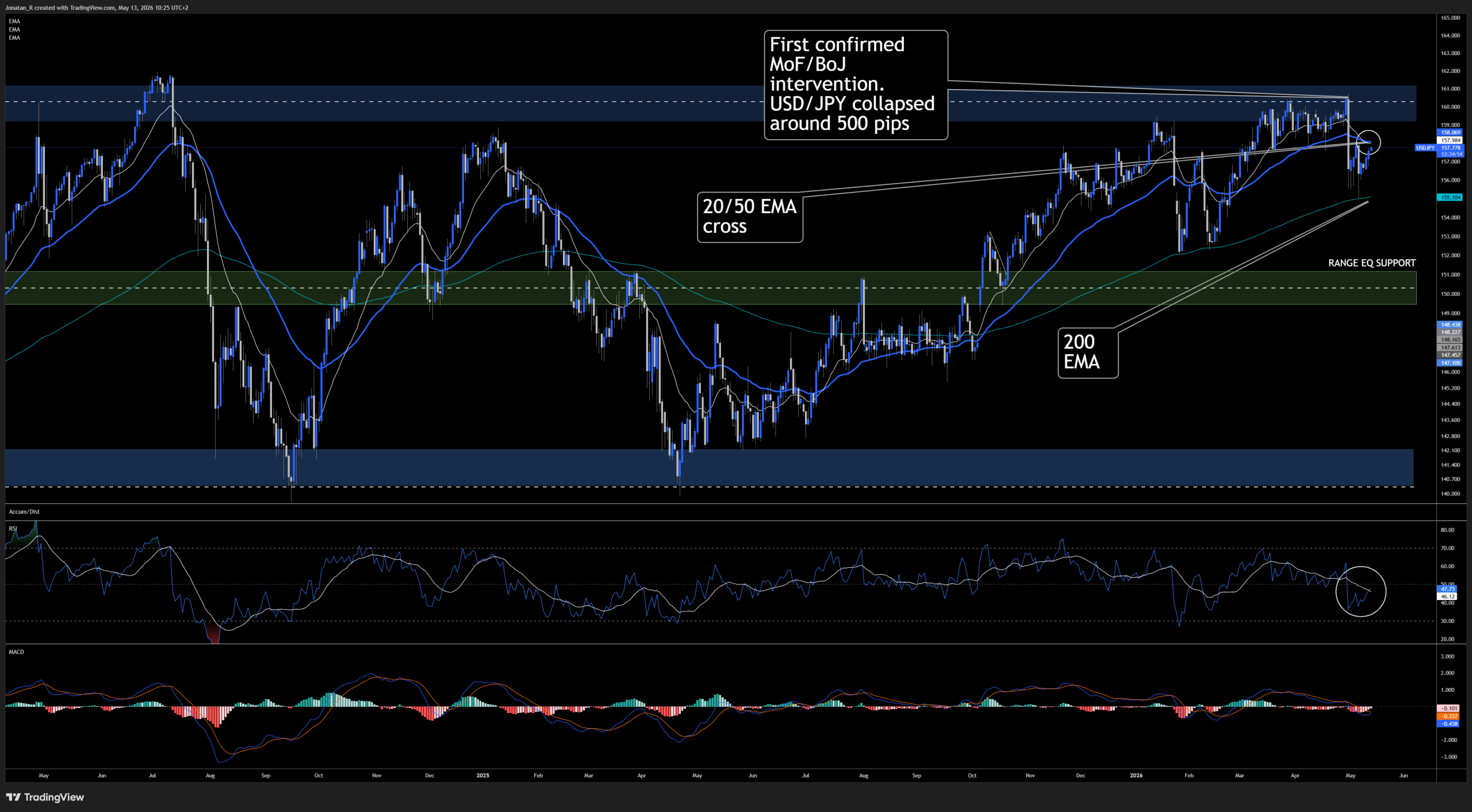
USD/JPY recently tested the range highs around 161, the same zone where Japan intervened in 2024 and where the carry trade unwound aggressively that August. This area has acted as resistance multiple times since July 2023, with the pair trading in a broad range between the highs above 160 and the range lows near 140.
The pair has been in a strong uptrend, but a few daily signals are starting to flash caution:
- 30 April intervention: USD/JPY collapsed around 500 pips in minutes, the sharpest one-day drop in over three years
- 200 EMA acting as support: The recent drop found support at the 200 EMA, the same level that held the pair on 28 January and again on 12 February
- 20/50 EMA cross: The 20 EMA appears to be crossing below the 50 EMA, a momentum signal that has preceded broader pullbacks in past cycles
- RSI in bearish territory: The daily RSI has broken below the middle line, which could potentially mark an entry into a bearish range
- MACD confirming the picture: The MACD line is below its signal line, both have crossed below zero, and the histogram is printing growing red bars. That’s three momentum signals aligned at the same area
The trend is still strong and the carry trade is still pulling buyers in on every dip. But the combination of intervention rejection, EMA cross, bearish RSI range, and confirming MACD could be the early stages of a topping formation at the range highs.
Key levels to watch
- Range highs around 160 to 161: The intervention zone and the long-term ceiling that has rejected price multiple times since 2023
- 200 EMA around 155: The first major support, currently holding the recent pullback
- Range EQ support around 150: The major level below. A break below the 200 EMA could potentially open the door here
- Range lows around 140: The far downside target if the carry trade were to unwind aggressively, similar to the move we saw in August 2024
What to watch
- PPI today as the second inflation read of the week
- US retail sales on Thursday
- Senate Fed Chair confirmation vote on Friday
- Trump-Xi summit on Thursday and Friday for any developments on Iran
- Fresh verbal warnings or intervention from Tokyo, particularly if the pair pushes back toward 158 or higher
- The BoJ meeting on 15 to 16 June as the most concrete near-term catalyst that could shift the rate differential
Trading involves risk.
Author



 Risk Disclaimer
The content provided here is for informational purposes only. It is not intended as personal investment advice and does not constitute a solicitation or invitation to engage in any financial transactions, investments, or related activities. Past performance is not a reliable indicator of future results.
The financial products offered by the Company are complex and come with a high risk of losing money rapidly due to leverage. These products may not be suitable for all investors. Before engaging, you should consider whether you understand how these leveraged products work and whether you can afford the high risk of losing your money.
The Company does not accept clients from the Restricted Jurisdictions as indicated in our website/ T&C. Some services or products may not be available in your jurisdiction.
The applicable legal entity and its respective products and services depend on the client’s country of residence and the entity with which the client has established a contractual relationship during registration.