5 min read
 Ethereum, Bitcoin and the broader cryptocurrency market are holding steady on Thursday, showing resilience following cooler-than-expected U.S. inflation data and despite elevated global bond yields.
Data yesterday showed that U.S. core PCE, the Fed’s preferred gauge for inflation, rose 0.2% month-on-month, below the 0.3% expected. As a result, markets have reined in October Fed rate hike expectations to just 37%, down from 70% at the start of the week.
While lower Fed rate hike expectations are offering some support to risk assets such as Ethereum and Bitcoin, U.S. Treasury yields are continuing to rise.
The sell-off in U.S. Treasuries has lifted 10-year Treasury yields to their highest levels since 2002. The move has also spread to Europe, where the UK 30-year gilt yield has climbed above 6% for the first time since 1998, while French bond yields are at multi-decade highs.
Higher yields increase borrowing costs across financial markets and can reduce liquidity available to risk assets. They also increase the opportunity cost of holding non-yielding assets such as Bitcoin and Ethereum.
Furthermore, the U.S. dollar has risen to a two-month high, tracking Treasury yields higher. A stronger dollar has historically been a headwind for Bitcoin and Ethereum, adding another layer of pressure to the cryptocurrency market.
Institutional Demand Softens
Institutional demand for Ethereum has softened, with Ether ETFs recording net outflows of $59.58 million on Wednesday, marking the second consecutive day of withdrawals.
However, net inflows across September remained strong at $832.4 million, marking the third consecutive month of net inflows.
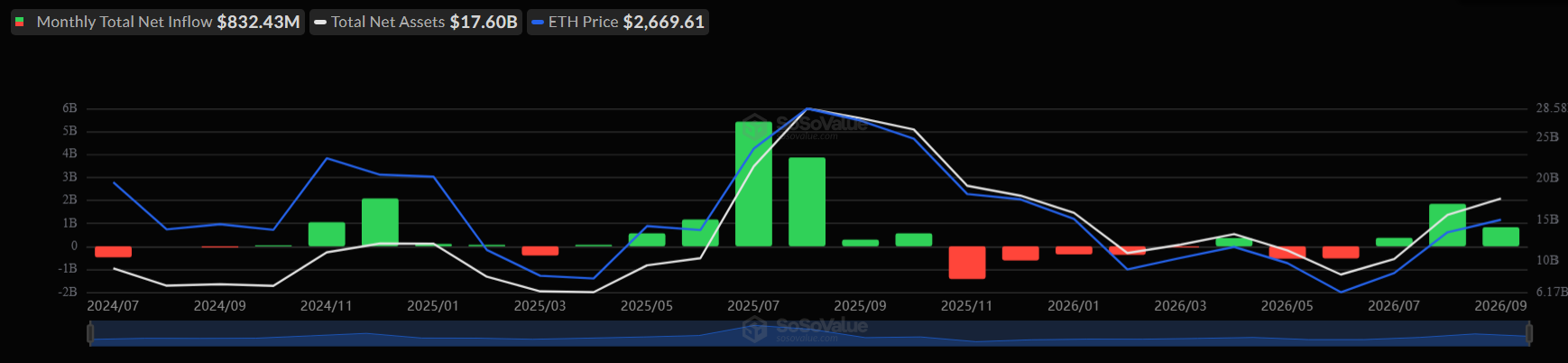
For ETH to extend its Q3 outperformance into Q4, improving institutional demand will likely need to offset the liquidity headwind created by elevated bond yields and a stronger dollar.
Meanwhile, Bitmine Immersion Technologies announced ETH holdings of more than 6 million tokens, equivalent to 4.9% of total ETH supply.
Ethereum Seasonality: Can Q4 Deliver?
Heading into the final quarter of the year, seasonality also comes into consideration.
Interestingly, while Q4 is historically the strongest quarter for Bitcoin, with average gains of 71% dating back to 2013, this is not the case for Ethereum.
Ethereum has historically recorded stronger average gains in Q1 and Q2, at 66% and 55%, respectively, while Q4 has produced average gains of 17% dating back to 2016.
This suggests that Ethereum enters Q4 with a less supportive seasonal backdrop than Bitcoin, although current positioning and macroeconomic conditions remain more important than historical seasonality alone.
Ethereum Technical Analysis
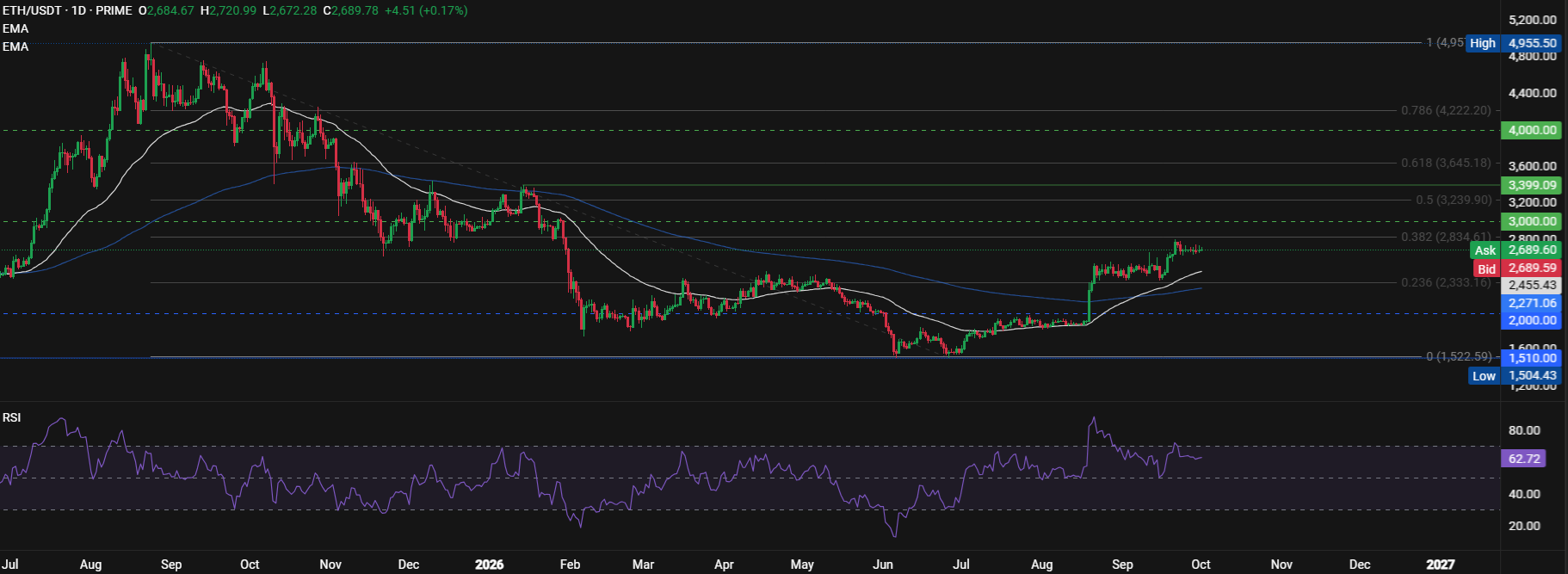
ETH maintains a bullish bias, holding above its 50- and 200-day EMAs.
The price is consolidating below $2,700, allowing the RSI to move out of overbought territory and potentially creating room for another move higher.
Should momentum pick up, buyers will look to rise above $2,800, the 38.2% fib retracement of the 4955 high and 1500 low, bringing the psychological $3,000 level into focus.
On the downside, a cluster of support is seen at the 50 EMA at $2,460, followed by $2,350, the 23.6% fib level. Below here, attention turns to the 200 EMA at $2,310.
Trading involves risk.
Author

 Risk Disclaimer
The content provided here is for informational purposes only. It is not intended as personal investment advice and does not constitute a solicitation or invitation to engage in any financial transactions, investments, or related activities. Past performance is not a reliable indicator of future results.
The financial products offered by the Company are complex and come with a high risk of losing money rapidly due to leverage. These products may not be suitable for all investors. Before engaging, you should consider whether you understand how these leveraged products work and whether you can afford the high risk of losing your money.
The Company does not accept clients from the Restricted Jurisdictions as indicated in our website/ T&C. Some services or products may not be available in your jurisdiction.
The applicable legal entity and its respective products and services depend on the client’s country of residence and the entity with which the client has established a contractual relationship during registration.