14 min read
 IOTA (IOTA) is the native token of the IOTA network, a distributed ledger built for feeless data and value transfer between machines, sensors, and applications. It trades near $0.034 in early August 2026, more than 99% below its 2017 record and deep in the aftermath of a full network rebuild. The token traded as MIOTA for most of its history; after the May 2025 “Rebased” upgrade it is quoted simply as IOTA. This page sets out PrimeXBT’s price outlook for IOTA through 2030 and out to 2050, the technical levels traders are watching now, and the catalysts that could push the price either way. Figures are our own estimates, given as ranges rather than false-precise targets, and where the picture is genuinely uncertain we say so.
IOTA outlook at a glance
- 2026 base case: $0.0309–$0.0394, a year of consolidation near current levels rather than recovery.
- Main bullish catalyst: traction from the Rebased network — staking, the Move smart-contract stack, and real-world tokenization pilots pulling activity back on-chain.
- Biggest downside risk: thin liquidity and a sustained break below the $0.032 support, with the token already under both its 50- and 200-day averages.
- Long-term view: a slow, uneven climb is the base case, but any figure past 2030 reads as a direction of travel, not a number to bank on.
Live IOTA price chart
Trading involves risk.
IOTA price prediction 2026–2030 (yearly forecast)
The table below sets our expected range for each year, built from a continuous month-by-month path rather than picked out of the air. Third-party targets that rest on very different assumptions, and that disagree wildly, are kept in the analyst section instead of blended in here.
| Year | Minimum | Average | Maximum |
|---|---|---|---|
| 2026 | $0.0309 | $0.0349 | $0.0394 |
| 2027 | $0.0336 | $0.0474 | $0.0659 |
| 2028 | $0.0518 | $0.0682 | $0.0830 |
| 2029 | $0.0445 | $0.0607 | $0.0802 |
| 2030 | $0.0403 | $0.0547 | $0.0675 |
IOTA price prediction 2026
Our 2026 outlook keeps IOTA close to its early-August level near $0.034, a range of $0.0309–$0.0394 averaging near $0.035, with no return toward the highs of past cycles. The token is under both key moving averages and sentiment is fearful, so the base case is a flat, grinding year rather than a turn. For the rest of 2026 the month-by-month view holds IOTA in a narrow band:
| Month (2026) | Minimum | Average | Maximum |
|---|---|---|---|
| August | $0.0309 | $0.0340 | $0.0371 |
| September | $0.0313 | $0.0345 | $0.0377 |
| October | $0.0316 | $0.0350 | $0.0384 |
| November | $0.0319 | $0.0354 | $0.0389 |
| December | $0.0322 | $0.0358 | $0.0394 |
IOTA price prediction 2027
2027 is where a recovery could start to show. Our path lifts gradually across the year for a full-year range of $0.0336–$0.0659, averaging near $0.047. The step up leans on the Rebased network maturing — more validators, more staked supply, more applications live — not on a single event.
| Month (2027) | Minimum | Average | Maximum |
|---|---|---|---|
| January | $0.0336 | $0.0375 | $0.0414 |
| February | $0.0350 | $0.0392 | $0.0435 |
| March | $0.0365 | $0.0410 | $0.0455 |
| April | $0.0379 | $0.0427 | $0.0475 |
| May | $0.0393 | $0.0444 | $0.0496 |
| June | $0.0407 | $0.0461 | $0.0516 |
| July | $0.0422 | $0.0480 | $0.0538 |
| August | $0.0438 | $0.0500 | $0.0562 |
| September | $0.0454 | $0.0520 | $0.0586 |
| October | $0.0470 | $0.0540 | $0.0610 |
| November | $0.0485 | $0.0560 | $0.0635 |
| December | $0.0501 | $0.0580 | $0.0659 |
IOTA price prediction 2028
2028 holds the cycle high in our model. The path peaks mid-year before easing back, for a range of $0.0518–$0.0830 and an average near $0.068. We place the next cyclical top in this window, in step with the broader post-halving crypto rhythm that tends to carry smaller altcoins last and hardest.
| Month (2028) | Minimum | Average | Maximum |
|---|---|---|---|
| January | $0.0518 | $0.0602 | $0.0685 |
| February | $0.0535 | $0.0623 | $0.0712 |
| March | $0.0551 | $0.0645 | $0.0738 |
| April | $0.0568 | $0.0666 | $0.0765 |
| May | $0.0584 | $0.0688 | $0.0791 |
| June | $0.0600 | $0.0709 | $0.0818 |
| July | $0.0606 | $0.0718 | $0.0830 |
| August | $0.0601 | $0.0715 | $0.0828 |
| September | $0.0596 | $0.0711 | $0.0826 |
| October | $0.0591 | $0.0707 | $0.0824 |
| November | $0.0586 | $0.0704 | $0.0822 |
| December | $0.0580 | $0.0700 | $0.0820 |
IOTA price prediction 2029
2029 is the cool-down after the peak, a measured drift lower through the year, ranging $0.0445–$0.0802 with an average near $0.061. High-beta altcoins usually give back part of a cycle advance before the next base forms, and IOTA’s thin float makes that retracement quicker than it is for large caps.
| Month (2029) | Minimum | Average | Maximum |
|---|---|---|---|
| January | $0.0564 | $0.0683 | $0.0802 |
| February | $0.0549 | $0.0666 | $0.0784 |
| March | $0.0533 | $0.0649 | $0.0766 |
| April | $0.0517 | $0.0632 | $0.0748 |
| May | $0.0501 | $0.0615 | $0.0729 |
| June | $0.0486 | $0.0598 | $0.0711 |
| July | $0.0475 | $0.0587 | $0.0699 |
| August | $0.0469 | $0.0582 | $0.0695 |
| September | $0.0463 | $0.0576 | $0.0690 |
| October | $0.0457 | $0.0571 | $0.0685 |
| November | $0.0451 | $0.0565 | $0.0680 |
| December | $0.0445 | $0.0560 | $0.0675 |
IOTA price prediction 2030
Our 2030 view spans $0.0403–$0.0675, averaging near $0.055. Five years out, the outlook rests on the network’s direction more than on any dated figure, so treat the monthly path below as the shape of a recovery, not a schedule of targets.
| Month (2030) | Minimum | Average | Maximum |
|---|---|---|---|
| January | $0.0442 | $0.0558 | $0.0675 |
| February | $0.0439 | $0.0557 | $0.0675 |
| March | $0.0437 | $0.0555 | $0.0674 |
| April | $0.0434 | $0.0554 | $0.0674 |
| May | $0.0431 | $0.0552 | $0.0674 |
| June | $0.0428 | $0.0551 | $0.0673 |
| July | $0.0425 | $0.0548 | $0.0672 |
| August | $0.0420 | $0.0545 | $0.0669 |
| September | $0.0416 | $0.0541 | $0.0666 |
| October | $0.0411 | $0.0537 | $0.0663 |
| November | $0.0407 | $0.0534 | $0.0660 |
| December | $0.0403 | $0.0530 | $0.0657 |
IOTA long-term price prediction: 2035, 2040–2050
Numbers a decade out are storytelling with decimal points. No model can price ten years of issuance changes, macro regimes, and technology shifts that have not happened yet, and the error band widens with every year added. On that understanding, our long-range path drifts higher without ever going vertical: an average near $0.09 in 2035, near $0.14 in 2040, and near $0.25 by 2050. Even the top of that range keeps IOTA far below its 2017 record.
| Year | Minimum | Average | Maximum |
|---|---|---|---|
| 2035 | $0.0666 | $0.0900 | $0.1134 |
| 2040 | $0.0952 | $0.1400 | $0.1848 |
| 2050 | $0.1500 | $0.2500 | $0.3500 |
What analysts and models say (compared)
Forecasts for IOTA sit at opposite ends of the map, which is the honest headline here. Algorithmic models split between an outright downtrend and a steady climb, while community-submitted predictions barely move off the current price. Averaging outputs built on incompatible assumptions would mislead, so they are laid out side by side.
| Source | Method | IOTA view (2026 unless noted) |
|---|---|---|
| CoinCodex | Algorithmic | Avg ~$0.032 in 2026, sliding toward ~$0.011 by 2030 (bearish) |
| Changelly | Algorithmic | Avg ~$0.139 in 2026, ~$0.645 by 2030 (bullish) |
| Binance (community predictions) | User-submitted | ~$0.034–$0.044 near-term; longer years flagged “too low to predict” |
The gap is the point. CoinCodex reads the death cross and extreme-fear sentiment as a downtrend that deepens; Changelly extrapolates a multi-year uptrend off the same starting price. Both cannot be right, and the disagreement itself tells you how little conviction the market carries on IOTA right now. Our own forecast lands between the two and closer to flat, weighted toward what the Rebased network actually ships rather than toward either extreme.
Track record of this forecast
This is the first IOTA forecast published in PrimeXBT’s monthly series in this format. From the next review onward, this section will hold the previous forecast up against IOTA’s actual price on the update date and explain any gap plainly instead of quietly moving the goalposts. Publishing the misses is the point of keeping the log.
IOTA technical analysis
IOTA trades below both of its most-watched moving averages, the mark of a market that has not yet turned. It sits under the 50-day simple moving average near $0.037 and well under the 200-day near $0.056, and the 50-day has crossed beneath the 200-day, a “death cross” that traders read as sustained downside pressure. The RSI reads near 43, neutral, with no oversold snap-back signal and no overbought warning. The Fear & Greed Index sits around 25, in “extreme fear.”
The support and resistance levels that matter now: near-term support around $0.033, then $0.032, with the token already testing that floor; resistance overhead at roughly $0.034, then $0.035. The line that would signal a real change of trend is the 200-day average near $0.056 — reclaiming it, and holding, is what separates a bounce from a recovery. For a primer on reading these signals, see PrimeXBT’s guide to crypto technical analysis.
Correlation with other assets
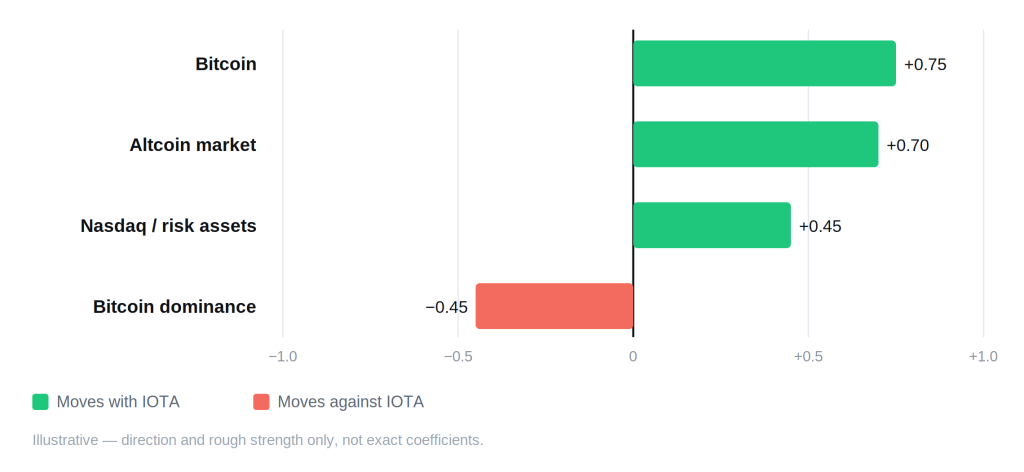
IOTA trades as a high-beta altcoin, which means it tends to amplify Bitcoin’s moves in both directions rather than chart its own course. When capital rotates toward Bitcoin and Bitcoin dominance climbs, thin-liquidity alts like IOTA usually lag hardest; when money rotates back down the risk curve, they can outrun the majors. IOTA also moves with the wider altcoin cohort and, since the market institutionalized, with risk assets like the Nasdaq, so Federal Reserve policy reaches its price through the same door it reaches equities. What sets IOTA apart is how sharply it reacts to its own project news — a Rebased milestone, an EVM release, a tokenization or trade-logistics partnership can override the broader tape for days, precisely because daily volume is small enough for a single narrative to move it. There is no meaningful gold or dollar-index story here; IOTA is a bet on network adoption and market risk appetite, not a haven.
Fundamental factors
IOTA did not start as a blockchain. Its original design, the Tangle, is a directed acyclic graph — transactions confirm one another instead of being batched into blocks by miners — built to move data and value between machines with no fees, aimed squarely at the Internet of Things. For years the network leaned on a central Coordinator node for security, and removing it (“Coordicide,” later IOTA 2.0) was the long-running project that defined the token’s technical story.
The May 2025 “Rebased” upgrade reset that story. IOTA moved to an object-based ledger running the Move virtual machine, and switched to delegated proof-of-stake with permissionless validators, so holders can now stake IOTA or delegate it and earn rewards. That change also rewrote the supply model. The old fixed cap near 2.78 billion gave way to dynamic issuance — the protocol mints new IOTA each epoch, an inflationary schedule starting near 6% a year, partly offset by burned transaction fees. Circulating supply now runs above 4.5 billion of a total near 4.95 billion. An EVM layer added Solidity smart contracts alongside the native Move stack, widening the developer pool.
Adoption is where IOTA’s case has always been argued. The IOTA Foundation has pushed real-world pilots in supply-chain tracking, digital identity, and trade logistics, including work with European industry and public-sector partners. These are genuine, but they are pilots and integrations rather than fee-generating usage at scale, and the token’s price has never tracked them closely. The honest read: the technology is more capable after Rebased, adoption remains a promise more than a number, and inflation is now a headwind the old IOTA never had.
Upcoming catalysts
Only confirmed, dated events are listed. With IOTA now trading like a risk asset, macro policy is the clearest near-term driver, and no IOTA-specific network event has a confirmed mainnet date at the time of writing.
| Date | Event | Potential impact |
|---|---|---|
| September 15–16, 2026 | FOMC meeting (with economic projections) | Bull if the Fed signals cuts; bear if it holds rates higher for longer |
| October 27–28, 2026 | FOMC meeting | Rate path drives risk appetite across the whole altcoin market |
| December 8–9, 2026 | FOMC meeting (with economic projections) | Year-end policy signal for 2027 positioning |
FOMC dates follow the Federal Reserve’s published 2026 schedule. No IOTA network upgrade is listed because none has a confirmed date — an invented one would be a guess, not a catalyst.
Bull case vs bear case
Bull case:
- Staking and delegation lock up a growing share of supply, thinning the float that can be sold.
- The Move stack and EVM layer attract developers, and pilots convert into recurring on-chain usage.
- The Fed shifts to cuts and capital rotates back down the risk curve into small-cap alts.
- A single credible tokenization or trade-logistics deal re-rates a token that moves easily on news.
Bear case:
- Adoption stays at pilot stage while ~6% issuance quietly dilutes holders.
- IOTA keeps lagging Bitcoin, pinned under its 200-day average with fearful sentiment.
- Thin liquidity cuts both ways, and a risk-off macro turn drains volume fast.
- The floor around $0.032 fails to hold and the downtrend extends.
Invalidation levels. The bull case loses its footing if IOTA closes and holds below $0.032, the nearest support. The bear case is invalidated on a sustained reclaim of the 200-day average near $0.056 — the level that would mark the downtrend as broken rather than paused. Both triggers are the same levels drawn in the technical section, watched from the other side.
Historical performance
IOTA’s chart is a story of one euphoric peak and a long descent. The token reached $5.25 in December 2017, at the top of that cycle’s mania, and has spent the years since grinding lower through failed recoveries, never reclaiming even a fraction of that high. The 2025 Rebased rebuild reset the technology but not the price, which still sits pennies above zero. A network can be rebuilt from the ground up; the market’s memory of a 99% drawdown takes far longer to fade.
Is IOTA a good investment in 2026?
Whether IOTA fits a portfolio comes down to horizon and appetite for risk, and the facts pull in two directions. Our outlook sees the token roughly flat into year-end, near a $0.035 average for 2026, with the market consolidating rather than breaking out. Underneath, IOTA is a small-cap altcoin with a rebuilt, more capable network, real staking yield, and genuine enterprise pilots — set against thin liquidity, a fresh inflationary supply model, and years of price disappointment. That combination reads as high-risk, high-conviction: a bet on a specific adoption thesis, not a broad-market hold. Whether the upside justifies the risk is the reader’s call.
How to trade IOTA on PrimeXBT
On PrimeXBT you can take a position on IOTA in either direction. CFDs on IOTA can be traded long or short, so you can act on a bullish or a bearish read without holding the token — useful for a low-liquidity alt that can move fast on news, and for short-selling weakness as readily as buying strength. Leverage magnifies gains and losses alike, so position sizing and a stop-loss carry more weight on a thin-float token than on a major. Trade on your own analysis and risk tolerance, and never risk more than you can afford to lose.
Trading involves risk.
How we build this forecast
This outlook is assembled by PrimeXBT’s analysts, not copied from a single price feed. We start from where IOTA trades today, read its position against the 50- and 200-day moving averages and the nearest support and resistance, weigh the fundamentals — staking demand, the new issuance schedule, the Move and EVM stacks, adoption pilots — and set all of it against the macro backdrop, chiefly the path of U.S. interest rates and market risk appetite. The yearly ranges combine that technical read with the fundamental and macro picture; the long-range figures lean on trajectory rather than precision.
None of this is a guarantee. IOTA is a thin, volatile small cap where one headline can move the price faster than any model expects, and the further out the forecast reaches, the softer it gets. Treat every figure here as a considered estimate, not a promise — we revisit and update the outlook monthly as the data changes.
How much will IOTA be worth in 2026?
Our outlook is roughly $0.0309–$0.0394 for 2026, averaging near $0.035 — a consolidation year rather than a recovery.
How much will IOTA be worth in 2030?
Our long-range view for 2030 averages near $0.055, within the range $0.0403–$0.0675. Five-year forecasts carry low confidence, so read that as a direction rather than a fixed target.
What will IOTA be worth in five years?
See 2030 above. On this horizon a single number is really a range spanning several cents in either direction, and the network's adoption path matters more than any point estimate.
Will IOTA reach $1?
Not on our numbers. Even the top of our long-range path sits near $0.25 by 2050, far below $1 and far below IOTA's own 2017 record of $5.25. Reaching $1 would take a stronger and more sustained cycle than anything in the current picture.
Author



 Risk Disclaimer
The content provided here is for informational purposes only. It is not intended as personal investment advice and does not constitute a solicitation or invitation to engage in any financial transactions, investments, or related activities. Past performance is not a reliable indicator of future results.
The financial products offered by the Company are complex and come with a high risk of losing money rapidly due to leverage. These products may not be suitable for all investors. Before engaging, you should consider whether you understand how these leveraged products work and whether you can afford the high risk of losing your money.
The Company does not accept clients from the Restricted Jurisdictions as indicated in our website/ T&C. Some services or products may not be available in your jurisdiction.
The applicable legal entity and its respective products and services depend on the client’s country of residence and the entity with which the client has established a contractual relationship during registration.